


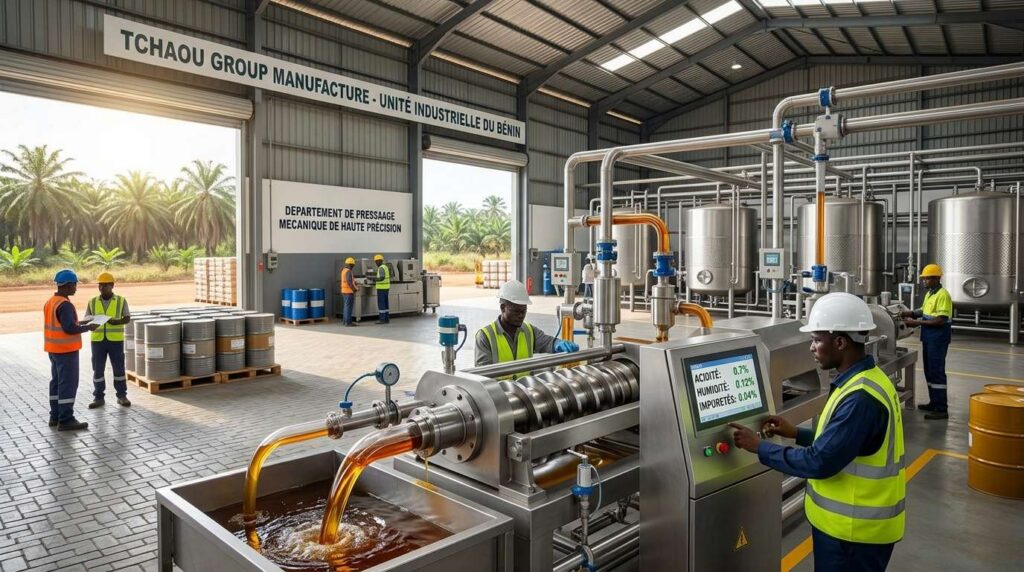
On the global market for industrial lipids and oleochemicals, the search for raw materials that are stable, traceable and processed to eco-responsible standards is no longer an option but a competitive imperative. Whether for advanced cosmetics, fine soap making or the large refining complexes of Asia and the Americas, identifying the right supplier of crude vegetable oils is a major strategic issue. At the heart of this reshaping of global supply flows, West Africa is emerging once again as an unavoidable hub. Carried by modern processing facilities and rigorous industrial expertise, the region offers a high-purity alternative to traditional supply chains. And as you will discover in this guide, TCHAOU GROUP MANUFACTURE is a key player in this trend.
The engineering behind crude vegetable oil manufacturing in Africa
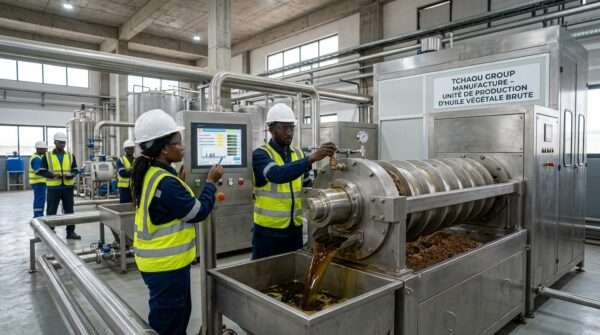
The manufacturing of crude vegetable oils has changed radically. It has moved beyond craft methods to adopt rigorous mechanical engineering standards. Today, the demands of international buyers call for strict control of physico-chemical parameters straight off the presses. Acid value, moisture content and the percentage of insoluble impurities are measured in real time.
Perfectly mastered mechanical extraction is the only guarantee of quality for refined crude vegetable oils. By minimizing the alteration of fatty acids during pressing, the result is a highly stable product. For the buyer, this translates into a sharp reduction in in-line losses during the later refining stages: degumming, neutralization, bleaching and deodorization.
In this fast-changing industrial landscape, TCHAOU GROUP MANUFACTURE has taken a leading position in Benin. By combining the wealth of local agricultural ecosystems with high-precision mechanical pressing processes, the industrial plant meets the most demanding specifications of global buyers point by point.
Product focus: crude palm kernel oil vs crude palm oil
For purchasing departments and international brokers, there is no room for confusion. Although both commodities come from the same tree (Elaeis guineensis), they come from distinct parts of the fruit and have completely different fatty acid profiles, which dictate their industrial applications:
- Crude palm oil (Crude Palm Oil – CPO): Extracted from the fleshy pulp of the fruit, it is characterized by a high proportion of palmitic acid (a saturated fatty acid) and oleic acid. Its texture and thermal stability make it suited mainly to the global food industries (frying oils, solid fats, biscuit making).
- Crude palm kernel oil (Crude Palm Kernel Oil – CPKO): Extracted exclusively from the kernel at the center of the nut. Its biochemical profile is radically different, dominated at close to 50% by lauric acid. This predominance of medium-chain fatty acids gives it exceptional surfactant and foaming properties. It is the raw material of choice for high-quality soaps, detergents, cosmetic emulsifiers and oleochemical intermediates.
TCHAOU GROUP MANUFACTURE: a crude palm kernel oil supplier you can rely on
To secure the supply chains of multinationals, choosing a crude palm kernel oil supplier or a crude palm oil supplier can no longer rest on simple trading intermediaries. Manufacturers require vertical integration or, at the very least, a direct partnership with the plant in order to guarantee the traceability of the raw material.
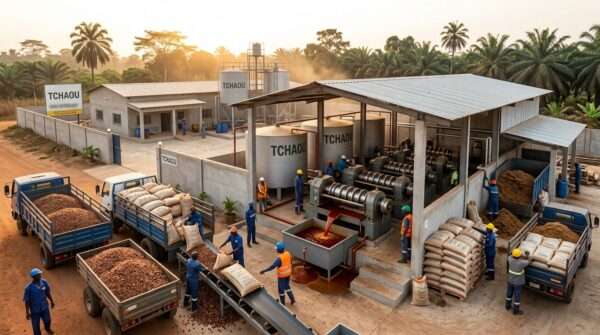
As apalm kernel oil exporter firmly rooted in Benin's industrial fabric, the group solves the complex equation of quantity and quality. A continuous supply of palm kernels is secured through a structured network of local collectors and farming cooperatives. This proximity to the resource guarantees fresh raw materials, preventing the early hydrolysis of lipids that is the main cause of rising FFA (Free Fatty Acid) levels.
By eliminating chemical solvents such as hexane during extraction, the plant delivers a crude oil of great native purity. The pressing residues (palm kernel cake) are put to use in animal feed, as part of a circular economy approach that international purchasing committees value more and more.
Export logistics and access to global markets

Industrial quality means nothing without flawless logistics. West Africa has a major geographical advantage for serving the Asian, American and European continents. From the processing plant to leading port infrastructure such as the deep-water port of Cotonou, the logistics chain is calibrated for large-scale bulk liquid transport.
To preserve the integrity of crude palm kernel oil over long sea voyages, packaging methods have been modernized:
- Flexitanks: These single-layer or multi-layer flexible tanks, fitted directly inside standard 20-foot containers, carry up to 24,000 liters of crude oil while minimizing contamination risks compared with traditional drums.
- IBCs (Intermediate Bulk Containers): Ideal for intermediate volumes destined for fine cosmetics units or regional soap works.
This logistical flexibility makes it possible to serve, with equal efficiency, a major refinery in Southeast Asia looking to diversify its sources, a North American soap maker requiring an undenatured crude product, or a fast-growing pan-African industrial player.
Conclusion: secure your production runs at the source
The global market for lauric oils is subject to constant volatility in prices and availability. Faced with this uncertainty, diversifying supply toward reliable industrial partners in Africa is the strategy adopted by market leaders.
By establishing itself as a key player in manufacturing of crude vegetable oils, TCHAOU GROUP MANUFACTURE does more than export volumes: it brings a guarantee of industrial yield, biochemical purity and logistical predictability to its partners worldwide. For your future short, medium or long-term supply contracts in crude palm kernel oil, choose industrial performance straight from the source.